
Ancient Wars I
In the past of the current Mexican territory, there were civilizations that carried by the hand of their great prosperity, created magnificent cities that over time, disputed resources and trade routes, creating huge and vast empires. This website aims to give you a broader and more general vision of how people and their destinies were interwoven through their wars:
The Ancient Wars!
Preclassic Period: Olmecs and Otomangues
In the beginning of time, two ethnic groups were the generators of civilization, and the ones who founded the most towns in this land. The best known are the Olmecs, whose name comes from the Nahuatl language and means “inhabitant of the land of rubber”, whose main cities in the pre-classic period are La Venta, San Lorenzo, Laguna de los Cerros and Tres Zapotes. Over time they founded other cities such as Xicalanco, Huexotzinco, Cacaxtla and Tlachihualtepec, now known as Cholula.
The other major ethnic group is called “Otomanguean” and according to recent studies, it may be even older than the Olmec – as evidenced by the archaeological site “Yatachio” located in the present municipality of Tamazulapan del Progreso, Oaxaca, whose archaeological studies conducted by INAH date with an antiquity of 4,000 to 6,000 BC, whose archaeological studies carried out by the INAH date it with an antiquity of 4,000 to 6,000 B.C. It is considered that the origin of the Otomangues is the Tehuacan-Cuicatlan valley, where the domestication of corn also has its origin. The Otomangues populated all the land and with the passing of the centuries, their language formed several other languages. The cities they built were usually in valleys, but they had to be walled to avoid being invaded by other peoples. To solve this problem, they began to found towns and cities on mountain tops to make them easier to defend militarily from any enemy.
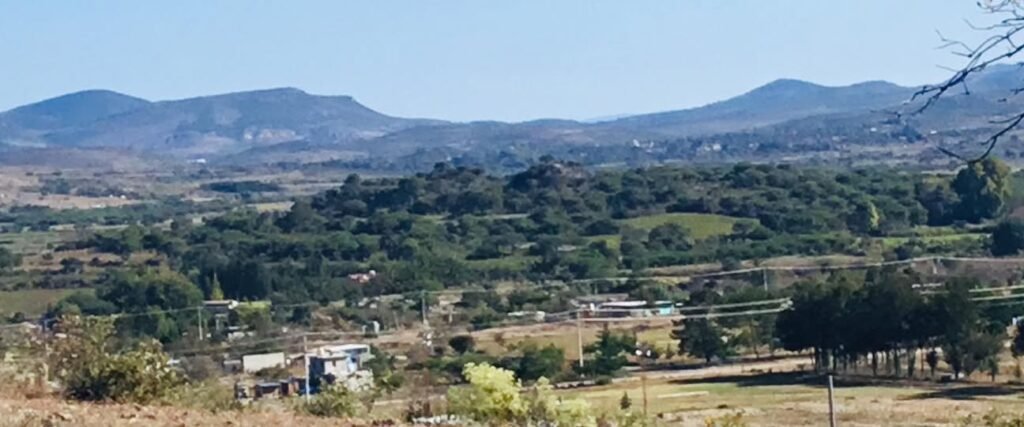
Yatachio archaeological zone (with monumental architecture) in the present municipality of Tamazulapam del Progreso, Oaxaca. Studied by Eulalia Guzmán, Alfonso Caso and INAH, but not yet rescued.
Trade and power: Dani Baan (Monte Alban), Teotihuacan, Tikal and Mixteca Ñuiñe
After the eruption of the Xitle volcano, which ended the magnificence of Cuicuilco, founded around 2100 BC, many of its inhabitants went to Teotihuacan, (founded between 300 BC and 100 BC) whose language is not known, nor how they named themselves, but in recent opinions it is considered that its founders must have been an Otomague-speaking people.
Tikal was founded around 600 B.C. in the middle of the vast jungle of the Peten, while Monte Alban was founded in 500 B.C. on the top of a mountain, in the current capital of the state of Oaxaca, which helped it become the capital of the then Zapotec kingdom.
I should also mention the territory of the Mixteca Baja, called “Ñuiñe” for its own style of writing, ceramics, sculpture and architecture, with Zapotec and Teotihuacan artistic influences, and whose center is the “Cerro de las Minas” (Huajuapan old town) in the current municipality of Huajuapan de León, Oaxaca, founded in the late preclassic period.
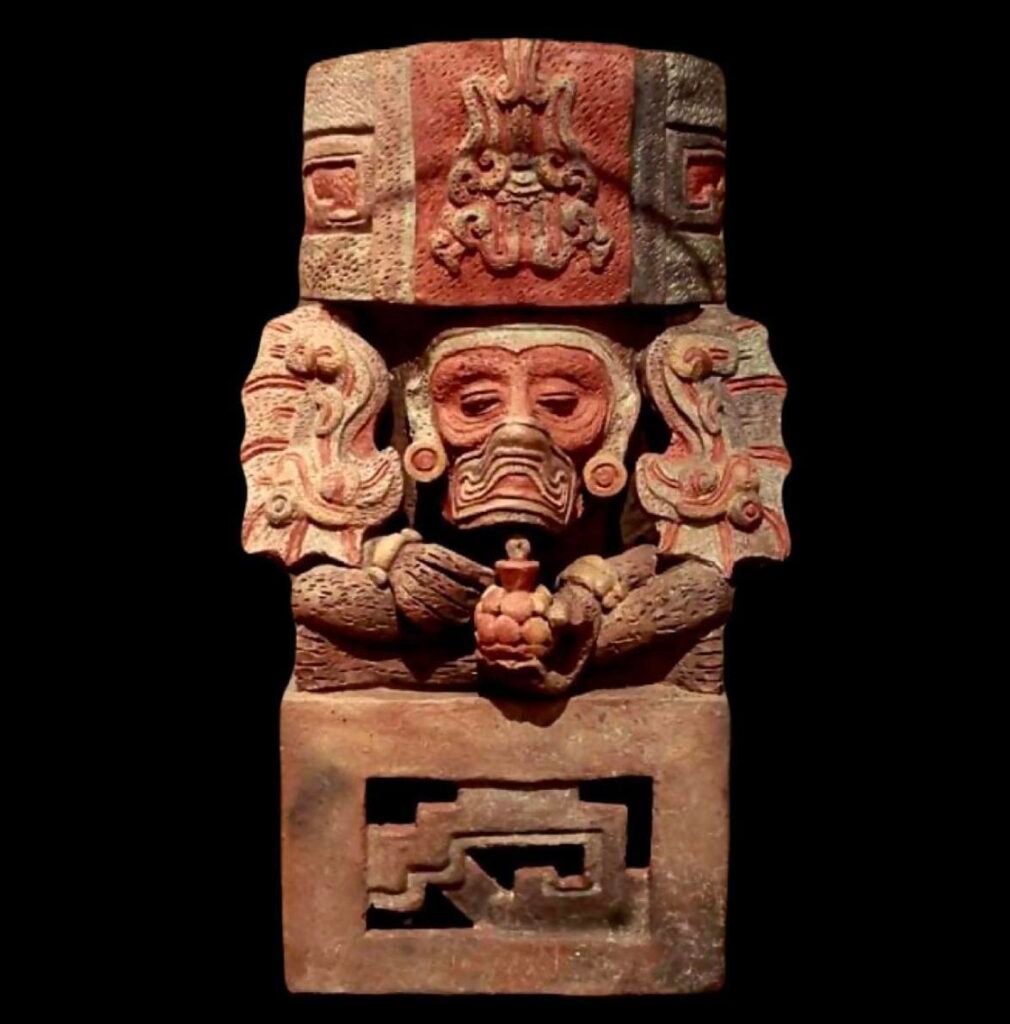
Sculpture of the “Old God” or “God of Fire”, from the Mixteca baja/Ñuiñe culture, Huajuapan de Leon, Oaxaca. Here you can see the Zapotec and Teotihuacan influence in its style.
In those ancient times, the Teotihuacanos extended their trade towards the Gulf of Mexico, and with it their influence. They also extended their commercial ties through the Mixtec territory, since the “Mixtec route” is the shortest way between Central America and the center of Mexico. In addition, the Mixtec territory is located in the middle of the Gulf of Mexico and the Pacific Ocean, which makes “la Mixteca” a territory of great wealth, full of great commercial activity, as we will see later on.
There is no evidence that the Teotihuacanos tried to invade the Mixtec territories militarily, but there is evidence of their cultural influence in the Mixteca Baja or Ñuiñe zone. What is known is that on their way to Central America, they came into conflict with the Zapotecs of Monte Alban, for control of trade routes, as well as gold for tribute. However, since the Zapotec capital was built on the top of the mountains, and was properly defended, it was impregnable for Teotihuacan.
Less fortunate, however, would be the great city of Tikal. Around 310 AD, Teotihuacan and Tikal had an established commercial relationship, but it was the abundance of exuberant resources such as jade and exotic feathers that motivated Teotihuacan’s ambitions. It was in the year 378 that “Búho Lanzadardos” sovereign of Teotihuacan, with the help of his general named “Siyaj K’ak'” (Fire that is born) defeated the Ajaw (King) “Chak Tok Ich’aak” (Jaguar Claw) ruler of Tikal, meeting his death that same day. Búho Lanzadardos put his son “Yax Nuum Ayiin” as the new ruler, marrying him to a princess, daughter of Chak Tok Ich’aak (Jaguar Claw) to start the new dynasty that would rule Tikal. The grandson of Búho Lanzadardos, ruler of Teotihuacan would be called Siyaj Chan K’awil (Stormy Sky), and since then both cities shared the destiny of both cities whose relationship, at the beginning prosperous, culminated in a dismal end, marked by the discontent of the lower social classes towards the ruling classes.
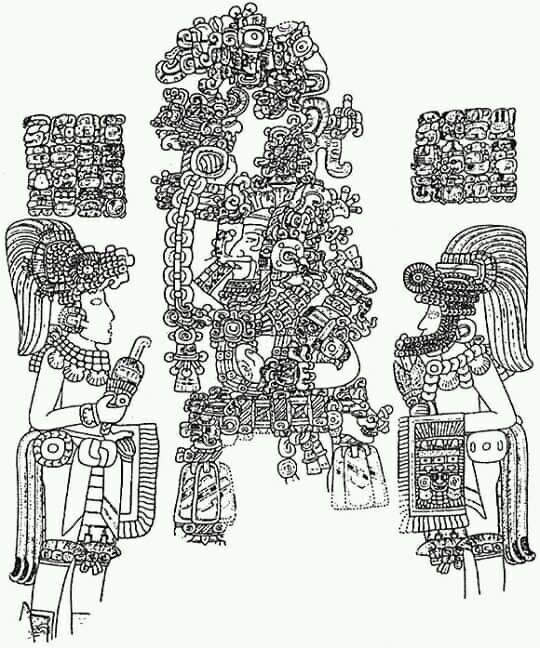
Stela 31, represents the conquest of Tikal in 378. On one side is Buho Lanzadardos, and on the other is his son, Yax Nuum Ayiin.
The fall of Teotihuacan, according to new studies carried out by archaeologist Linda Manzanilla, is located in the middle of the VI century, in the year 570 of our era. The reasons for the fall of the great imperial city are due to different factors: The internal cause is a generalized revolt by the Teotihuacan neighborhoods that together with their leaders would have achieved a certain autonomous power within the city. The reasons seem to be an excessive deforestation added to a prolonged drought and the appearance of new centers of power -like Cantona and Xochicalco, among others- that competed for the commercial routes, which resulted in Teotihuacan lack of food, lack of supplies and materials and a severe economic crisis, which the rulers of Teotihuacan could not contain.
Tikal versus Calakmul and “The Kingdom of the Serpent”.
Located in the north of today’s Yucatan Peninsula, Calakmul has its origins in the Preclassic, beginning its prominence in the Late Preclassic (400 BC – 250 AD). It began its political expansion through networks of influence made through alliances. Their “Kuchkabal” – a name in Maya to refer to a “kingdom” – was called “Kaan” which in Maya means “Serpent”, so that Calakmul was the capital of the “Kuchkabal Kaan”, i.e. “The Kingdom of the Serpent”.
It was in the 6th century, with “Tuun K’ab ‘Hix” that the alliances at the head of Calakmul came to the surface to confront each other later on. As an important antecedent, in the year 537, the “Ajaw” of Yaxchilan -a Mayan kingdom that had managed to be independent until then- made war on the “Ajaw” -Mayan name for governors- of Bonampak, Lakantuum and Calakmul, for the control of their respective parts of the Usumacinta River. Bonampak and Lakantuum were conquered, but Calakmul in revenge for this event, conquered Yaxchilan, thus obtaining a strategic position to the east and west of Tikal.
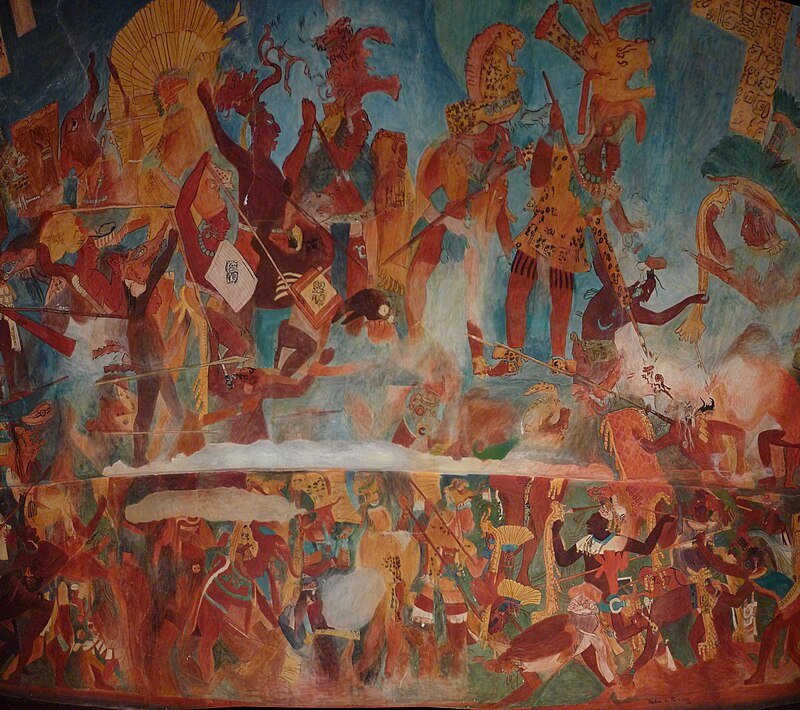
Bonampak mural depicting early military campaigns between Bonampak and Yaxchilan
Tikal, for its part, continued to be the only political and military superpower in the south, dominating key territories along the Usumacinta River, which gave it control of the richest commercial zone in the entire Yucatan Peninsula, setting the prices for merchandise traffic at will.
It was in the year 562 when Calakmul under the rule of “Witness of Heaven” launched its military offensive against Tikal. The Ajaw of Tikal was among those executed, and the rest became vassals of the flourishing super power coming from the north of the Yucatan Peninsula, marking a lapse of time of about 100 years without Tikal having any kind of prominence. This is how the Ajaw of Calakmul acquired the title of “Kolomte” which is king of kings and in Spanish would be synonymous with “Emperor”. After 572 “Uneh Chan” succeeds “Witness of Heaven”, organizing military campaigns like his predecessor, and taking the war to Palenque (Palenque, Chiapas) in the years 599 and 611.
In the year 636 “Yuknoom Ch’een II” came to power in Calakmul, leading the “Kingdom of the Serpent” to confront other kingdoms in order to expand its power. Meanwhile, in the anonymity that gave the silence of the supposed subordination, Tikal was gradually strengthened without raising any suspicion. In the year 620, two main cities known as “Caracol” and “El Naranjo” were at war. It is in the midst of this situation that Calakmul declared war on Tikal, returning the old enmity, in the year 657. Calakmul, however, managed to maintain and expand its hegemony in the high and low zones of the Usumacinta River.
In the year 686, Yuknoom Ch’een II was succeeded by his son “Yich’ak K’ahk'”, who would carry on his shoulders the legacy of his ancestors. In the year 695, Yich’aak K’ahk confronts “Jasaw Chan K’awiil”, the new Ajaw of Tikal who took power with the help of the noble classes and the people dissatisfied with the established situation. From this moment on, the war took on the magnitude of focusing on the total annihilation of one side or the other. The war was bloody, and the captains of the Kuchkabal Kaan i.e. of the “Kingdom of the Serpent” were defeated, captured and sacrificed. Calakmul was defeated, giving way to the consequent acts of humiliation, that the Ajaw Jasaw Chan K’awiil of Tikal, commanded to immortalize carved in one of the wooden lintels of Temple I of Tikal, in which the Ajaw of Tikal, declares that he captured the flint shield of Yich’ak K’ahk (Kolomte of Calakmul), dated August 5, 695 of our era.
In Calakmul there was an internal conflict, where the ruling elites deliberated. The solution was to open political and commercial relations with the kingdoms further north of the Yucatan Peninsula, and very helpful were the ancient relationships they had to the south with sites such as El Naranjo, Dos Pilas and El Peru (an archaeological site in Guatemala that should not be confused with the country “Peru”). Although Calakmul had been defeated militarily, it still maintained its autonomy and influence in important sectors of the Peninsula. However, the two protected kingdoms of Calakmul, El Naranjo and Peru are conquered by Tikal. The dismemberment of the Kingdom of the Serpent is inescapable, and with it the Late Postclassic comes to an end. From the 61st stela of the siege, it is known that in the year 909, the ruler of Calakmul “Aj Took” initiated the failed attempt of military recovery of Calakmul. The style of the stelae is decadent, trying to imitate those of the classical period. In the 10th century, Calakmul and other Mayan areas were abandoned, being used by a few small groups of settlers to carry out ritual activities – as happens today with many archaeological sites in the 21st century – and the Postclassic period began.
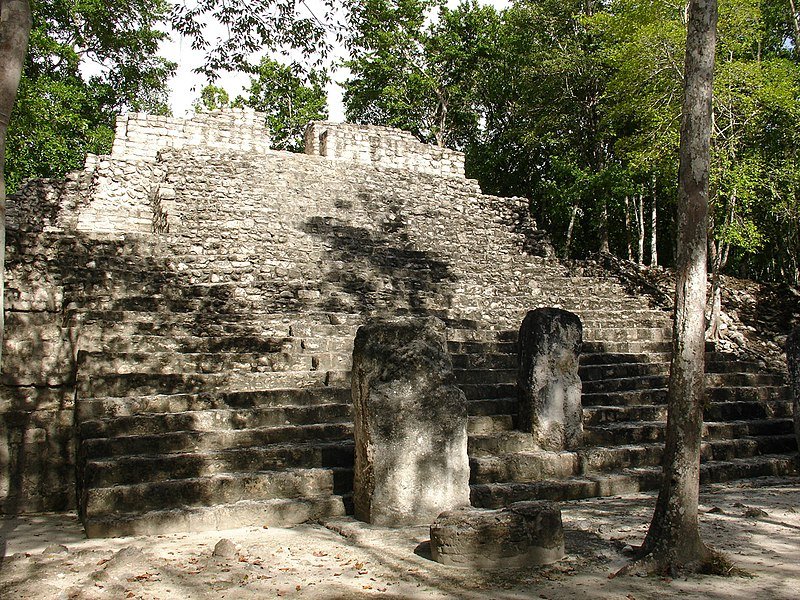
Site structure: Temple and stelae
For their part, wars forced people to focus more on the city of Tikal, which caused intensive agriculture and therefore the deterioration of the environment following erosion and deforestation, which resulted in a decrease in population. Tikal and its surroundings significantly lost population between 830 and 950. In the second half of the ninth century there was an attempt to reinstate royal power – as evidenced by a stele erected in the Great Plaza by “Jasaw Chan Jawiil II”, the last monument erected before the city fell silent. At the end of the IX century, the great majority of the population had abandoned the city, the palaces were occupied by illegal settlers, blocking the rooms with materials of the same city. Before the definitive abandonment of Tikal, the respect for the ancient rulers had disappeared, looting tombs of the northern necropolis, of which the most accessible were looted in search of jade. In the year 950 the city was almost uninhabited, and in the X and XI centuries the last inhabitants abandoned Tikal, and the jungle reclaimed the territory during the following millennium, giving way – as mentioned before – to the Postclassic Period.
The great Tula
Founded in the 7th century, around the year 713 by the Tolteca-Chichimeca, Tolteca Nonoalca and Tolteca-Otomí peoples. It is considered the successor of Teotihuacan and would constitute a complex social, political and cultural development for the society, showing its decadence towards the XII century. Its flourishing is largely due to the great King Quetzalcoatl -not to be confused with Quetzalcoatl as a deity- and its fall to the dispute between followers of the cult of Quetzalcoatl -the deity, not the king- and Tezcatlipoca, the latter being the victors and in whose charge was the destruction of the Great Tula, under waves of Chichimecas coming from the North of the current Mexican Republic.
When the great city of Tula was at its peak, it is said that an embassy from Tula went to the city of Huapalcalco (in the present municipality of Tulancingo de Bravo, Hidalgo) to meet with a young, middle-aged man by the name of “Dos Caña”, who served as a priest of the cult of Quetzalcoatl, and who had recently arrived in Huapalcalco. The tales of wisdom that were spoken of this young man were so famous that they had reached the great city of Tula. This retinue was looking for him to be the new ruler of Tula. After the interview, the young man explained that he had just arrived in Huapalcalco, and that after 4 years, in which he would live practicing a spiritual retreat, he would go to Tula to govern. So it was and at the end of those 4 years he went to the great Tula, where he would rule and would go down in history as a transcendental figure: The last living representative of Quetzalcoatl, -mythical character- who would give life forever to his legend, tried to overshadow later by Christianity, replacing him by force by Jesus.
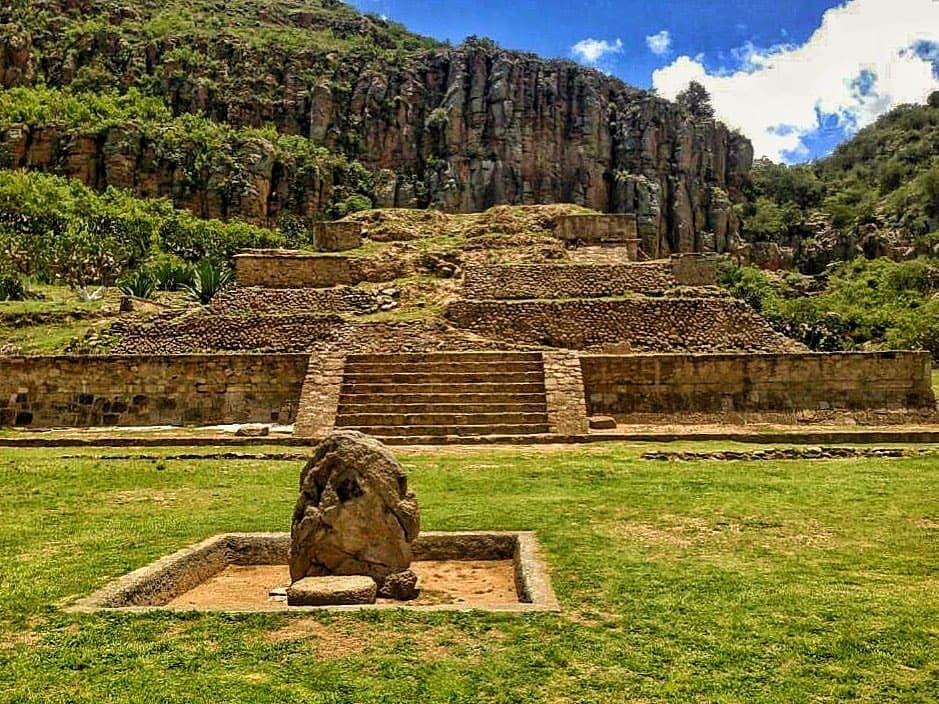
Archaeological zone “Huapalcalco” In the current municipality of Tulancingo de Bravo, Hidaldo, Mexico.
Chichen Itza
Chichen Itza has its origin around the year 250 AD. by people coming from the Peten (Belize) who passed through Bacalar, and who were looking for a more pleasant life and peace from the wars that already existed in places like Tikal, El Caracol, El Naranjo, and others, thus founding the great city that flourished through trade, being blessed by its great central cenote, which was a place of worship, related to Chaak (the Mayan god of rain) and the Xibalba (the place of eternal rest, known in Nahuatl as “Mictlán” and in Mixtec as “Añu’u Ndehui”) being thus a sacred cenote, to which after the European occupation, people and priests continued to leave offerings.
It was in Chichen Itza that an outstanding Kuchkabal or confederation was founded at the end of the Classic period and the beginning of the Postclassic period The Kuchkabal/Confederation of Mayapan, formed by priestly castes from Uxmal (Tutul Xiuhes) Mayapan (Cocomes), and Chichen Itza, as well as Ichkcaansiho (present day Merida, Yucatan, also known in ancient times as “Ichkcaansiho”), (Tutul Xiuhes) Mayapan (Cocomes), and Chichen Itzá, as well as from Ichkcaansiho (present-day Mérida, Yucatán, also formerly known as “T’Ho), Ek Balam, Izamal, Motul and Champotón, cities founded by the same people who came from the Peten.
Those people had to overcome the same trade problems as many of their successors and predecessors of this continent, finding the best trade route to the north of the current Mexican territory through the sea of the Gulf of Mexico, since by sailing its waters they could avoid toll charges and assaults, in addition to sailing the sea (bordering the coasts) they could reach their destinations faster. This captivated their greatest commercial allies, the Toltecs, and motivated them to migrate to Chichen Itza; an outstanding, rich and prosperous city, since by sailing the sea, the Toltecs could also avoid so many dangers to their commercial caravans within the different states that on earth had up to the current Yucatan Peninsula. It was through trade and peace that the Toltecs migrated to that distant and exuberant country.
After a while, the city had to be expanded to meet the needs of its growing population, and so a new center was built next to the old “Chichen Viejo”, which is the one we all know, illustrated by the following image
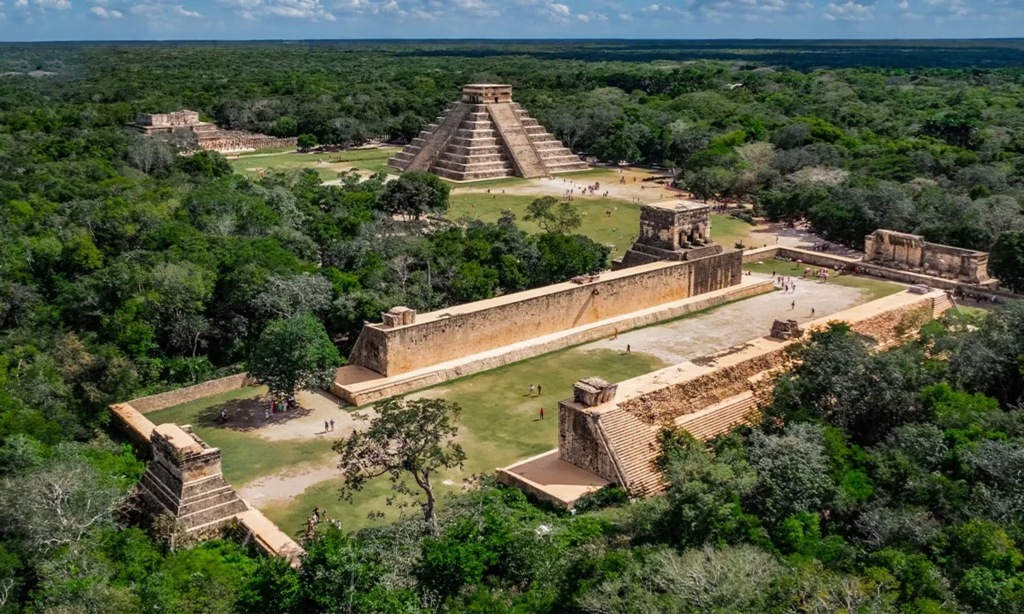
Image of Chichen Itza, and its city center.
The fall of Chichen Itza is mainly due to one of the “Halach Huinic” (King or Sovereign, in Maya language) called “Hunac Cel”, coming from Ichkcaansiho (Merida, Yucatan) and whose participation in history takes place a little after the fall of Tula, city of the Toltecs.
Cholula-Tlachihualtepetl Cholula-Tlachihualtepetl
The origins of Cholula (present-day Cholula, Puebla) date back to the 8th century B.D., originally founded by Olmec Xicalancas, who founded other important sites such as Cacaxtla, Cantona, Xochitecatl, Chalcatzinco and Xochicalco. In its beginnings, they were highly influenced by the cultural current of the Mixtec Ñuiñe, whose capital was Ñuu Ndee (Huajuapan de León, Oaxaca), as demonstrated by ceramics found by archaeological studies, and it was also a city that supplied Teotihuacan with ceramics, elaborated in the Mixtec Ñuiñe style.
In this city participated the Great Iya (Mixtec King) Eight Jaguar Paw deer to bring forced peace through war around the year 1057, according to studies of Codex Bodley and Tonindeye (Nuttal), since like Tula, it was besieged by numerous and multitudinous Chichimecas coming from the north of the current Mexican territory. It was a city with great commercial activity, and the probable cult to the god of Rain, where the Spaniards would later build on its summit, the parish of Our Lady of Remedies.
The legend says that the people of Cholula built with gigantic dimensions its main temple, however this at different times of its construction suffered damage, interpreted by the inhabitants as a sign that the gods did not want to build more, being a gigantic mound to the arrival of the Mexica of Tenochtitlan, and a hill more for Europeans in the sixteenth century.
In the year 1116, they were invaded by Chichimecas from Culhuacatepec, located in the hill of San Isidro Culiacán, in the state of Guanajuato, according to historian Paul Kirchhoff, although this information is highly debatable. Another name for this place is Chicomoztoc, the name by which it is better known.
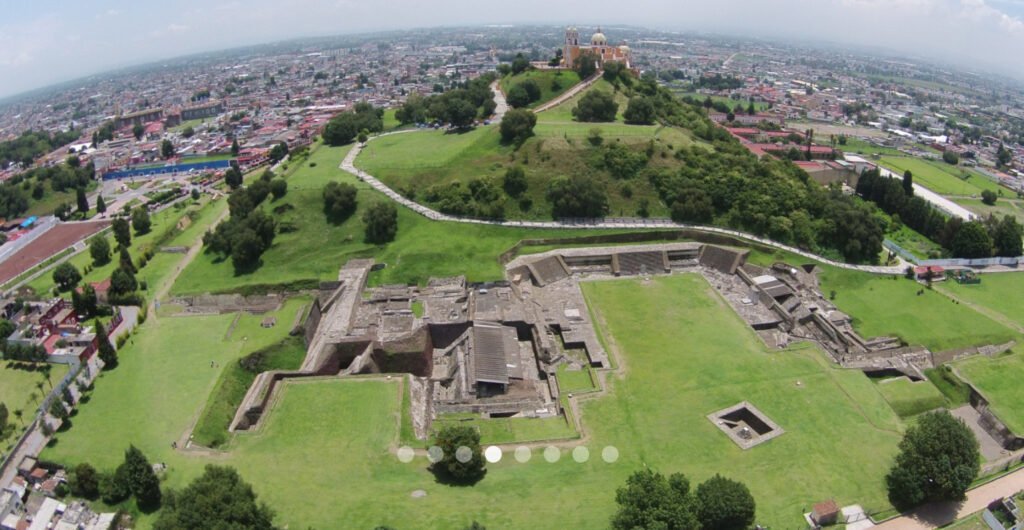
Image of the original Great Temple of Cholula, Puebla.
Eight Jaguar Claw Deer, and the Great Ñuu Dzahui/Mixteco Empire
It seems that the last great empire in Mexico was the one built by the great Mixtec conqueror Ocho Venado Garra de Jaguar, since the “Mexica Empire” actually had many successful uprisings, until its fall in 1521, but we will leave all that for Ancient Wars II.
In a time when everyone who could took his own piece of land, our hero was born in Ñuu Tnoo (Tilantongo, Oaxaca) on a day 8 Deer, in the year 12 Reed, 1063 A.D. His mother was Mrs. 11 Water Blue Bird, and his father was 5 Sun Rain Lizard, High Priest of the Temple of Heaven (Ve’e Andehui). After the death of the rulers and the royal family of Tilantongo, the only heir to the throne was Prince 2 Rain, who was only one year old and therefore, could not rule, being the Priest 5 Lagarto the regent governor.
As was the ancient Mixtec tradition, at the age of 7 years, the young 8 Venado received his second name “Garra de jaguar” given by the priests who were expert scholars of the calendar, and thus began his education in all the arts and knowledge, reaching the grade of “Ya’a Yahui” the highest grade as a priest, as they learned to be nahuales. At the same age, he also began his military education. At the age of 8 he participated in his first battle. Later, in the year 2 Caña, 1079 A.D., at the age of 16 he made his first military conquest, taking “The valley of the feathers of Quetzal” which is probably Ilhuitlán, a town located in the margins of Coixtlahuaca, Oax., before the foundation of that city.
However, in the year 5 Conejo, 1082 A.D., when 8 Deer Jaguar Paw was 19 years old, his father, Lord 5 Lizard, died. That same year, he went to Chalcatongo, Oax. to visit the Priestess of the “Ve’e Quin”, Temple of Death, Lady 9 Hierba, to ask her advice and counsel on his destiny. It was there where he met the princess 6 Mono Quechquemitl de Guerra, who was between 14 and 16 years old, and also went that same day to consult her destiny. It is not known exactly what was the relationship between the two young people, but it is theorized that they may have had an affair, and that the priestess of the Temple of Death knew it, foreseeing that together, they would be too powerful, and therefore separated them: To the princess 6 Monkey Quechquemitl of War, he sent her back to her land, which is the city of Añute (Jaltepec, Oaxaca), predicting for her that in time she would be the second wife of a great lord, which happened when Lord 11 Wind, originally from a city called “Bulto de Xipe” asked for her hand, being his second wife. To 8 Deer Jaguar Claw sent him to the coast, to establish himself as Iya (King) of the city that he himself would found, which is Yucu Dzaa (Tututepec, Oax.) giving him for this task a dart or venablo decorated with owl head, a shield with skull drawn, a gold fish, a snail trumpet, a turquoise brooch, and a glass to deposit hearts.
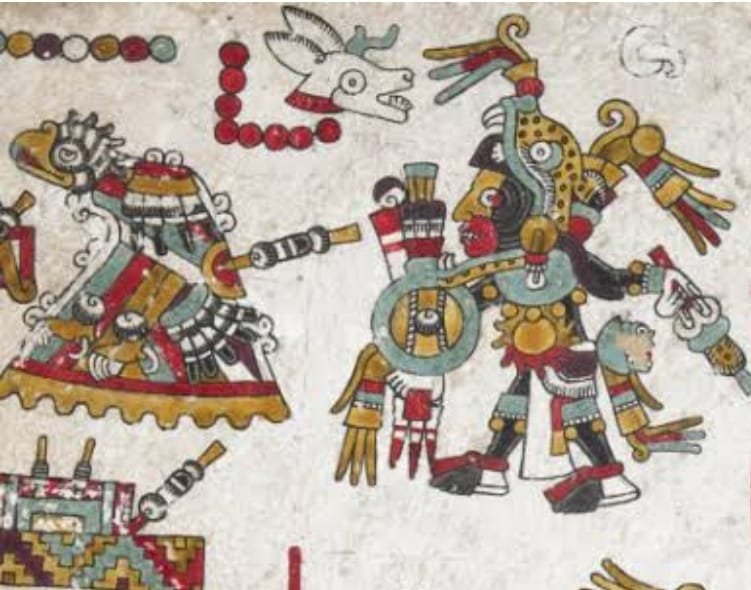
Image of 8 Jaguar claw deer conquering “El Cerro del Aguila” and “El Llano del Teponaxtli”, taken from the Tonindeye codice (Nuttal).
At the age of 20, along with his half brother and fellow warrior 12 Bloody Jaguar Movement, 8 Jaguar Claw Deer conquered 26 kingdoms, in the year 1084 A.D. 3 years later, in the year 7 House, 1087 A.D., he went to Yucu Yoo, “El Cerro de Luna” (The Hill of the Moon) (Acatlán de Osorio, Puebla) in the lower Mixtec, went to Yucu Yoo, “El Cerro de la Luna” (Acatlán de Osorio, Puebla) in the Mixteca Baja, conquering this important city on the 1st Wind of the same year, where his brother 12 Movement subdues and imprisons Lord 1 Movement, and 8 Deer captures Lord 3 Lizard. In this way, 8 Venado had conquered the Mixteca de la Costa and the Mixteca Baja, returning to Yucu Dzaa (Tututepec, Oax.).
8 Deer was in a temple inside a cave, performing propitiatory rituals for a new military campaign, when an entourage of 4 ambassadors arrived in Tututepec. His exploits had become famous, and the Tecuhtli (King) 4 Jaguar invited him to his city: Cholula. The reason was to negotiate with him a military and commercial pact, since the Governor of Cholula needed help to contain the constant invasions of Chichimecas coming from the north of the current Mexican territory, who at that time (besides besieging Tula) besieged Cholula and its territories. The alliance was agreed and celebrated with a ball game, where 8 Jaguar Claw Deer was the winner, and then went with his army to the city.
I must mention something important, and that is that there are scholars who believe that this Lord 4 Jaguar was the same Quetzalcoatl, wise King of Tula who after his shameful fall in Tula, went to Cholula and in a campaign of conquests, reached Chichen Itza along with 8 Jaguar Claw Deer, as we will see later.
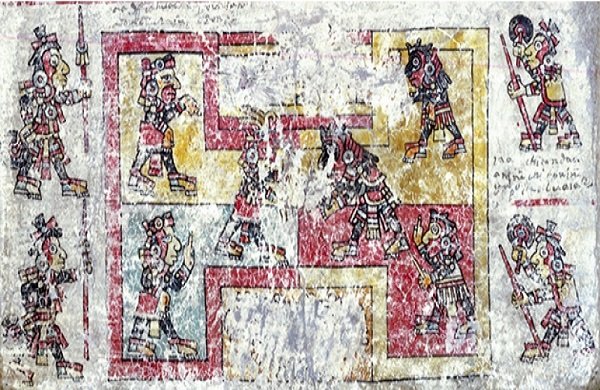
Image of the ball game held by 8 Jaguar Claw Deer and the Cholula embassy, to celebrate the military-commercial alliance.
8 Jaguar Claw Deer along with his army, pacified the entire area of Cholula and its surroundings, thus receiving from his ally and friend 4 jaguar the nariguera, a symbol originally Olmec Xicalanca, (later copied by the Toltecs) of great priests and rulers. Then he received a news: The young Iya (King) 2 Lluvia had died without leaving any heir, so the royal house of Tilantongo had been extinguished. This news opened the way for 8 Jaguar Claw Deer, since now he could claim by military conquest the city of Ñuu Tnoo (Tilantongo, Oax.), and so it was: He marched there with his ally 4 Jaguar and the armies of both. It was through this conquest that he unified the 3 Mixtec regions: the low, the coast, and the high, establishing in this city the capital of his new empire.
His next act was to summon all the Mixtec Lords to recognize him, and 112 Governors attended the civic ceremony, bearing gifts and presents, showing him obedience and respect. Thus, 8 Jaguar Claw Deer officially began its new lineage.
Following this, they began a new military campaign of conquest, where 8 Deer Jaguar Claw, 12 Movement Bloody Jaguar, and 4 Jaguar, campaign in which they reached the ends of the world submitting 60 peoples more, including some islands in the sea, and coming to war with the same Ñu’u Ndicandii (The Sun God, “Tonatiuh”) defeating him at the end of this campaign, as evidenced by the codex Tonindeye (Nuttal). After this, they arrived at Campeche, where they set out on their journey: 8 Jaguar Paw Deer and 12 Movement returned to Ñuu Tnoo (Tilantongo, Oax.) and 4 Jaguar headed for Chichen Itzá.
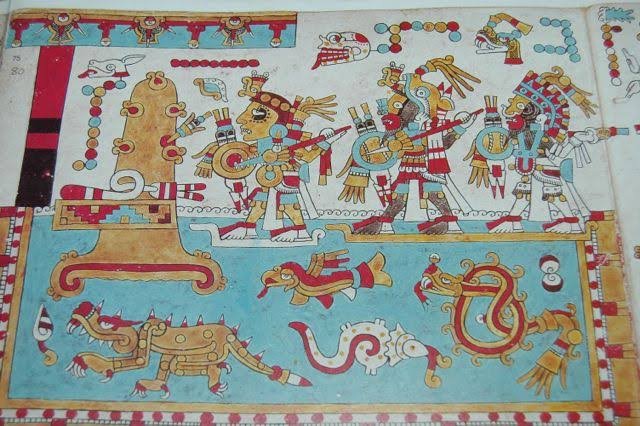
8 Deer, 12 Movement and 4 Jaguar going to the ends of the world in military campaign, according to the Tonindeye (Nuttal) codice.
Upon his return, 12 Movement decided to take a break, starting by taking a temazcal bath on the 11th day of Death of the year 10 Flint, 1100 AD, where he would receive a massage. However, the person who would give him said massage hid in the middle of a bunch of medicinal herbs a flint dagger, mortally wounding 12 Movement in the chest, inside the temazcal. This was a hard blow for 8 Deer, who ordered an investigation of the fact, having as a result that this death was orchestrated in the city known as “Bulto de Xipe”, ordered by the Lord called 11 Movement, the husband of the princess 6 Monkey Quechquemitl of War.
Jaguar Claw Deer celebrated a funeral ceremony worthy of a King to his brother and inseparable companion, taking a whole year of mourning after that.
At the end of that year, 8 Deer undertook a punitive military campaign against the city of Bulto de Xipe, capturing 11 Movement, 6 Monkey, and his sons 4 Wind, 10 Dog and 6 House. For some unknown reason, 8 Venado let 4 Viento (who was a child) escape, which would later become his biggest mistake. Meanwhile, full of rage, he executed the other two who were older: 10 Perro was executed in a fight with two opponents, one of whom was the same 8 Deer Jaguar Claw. This execution was carried out on the “Temalacatl”, which was a stone on which the sentenced person was tied by one foot and was forced to fight to death, while the execution of 6 Casa was by arrowing, on a platform where there were two wooden beams placed diagonally, where the sentenced person was tied by feet and hands to be arrowed.
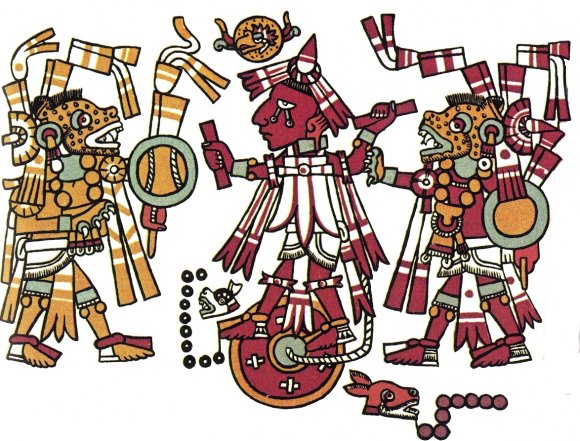
Image of the codice Tonindeye (Nuttal) where you can see in the middle the prince 10 Perro, being executed by 2 jaguar warriors, one of them is 8 Venado Garra de Jaguar, who is dressed in red (right).
After this, 8 Jaguar Paw Deer dedicated himself to govern and enjoy his empire, which enjoyed a great internal and external trade without obstacles or problems. Away from military campaigns, he enjoyed going out and about, and one of his favorite activities was hunting and capturing birds. This is how time went by, until he was 52 years old. One day when he was out of the house, he was ambushed by 4 Viento who confederated with other Mixtec people, stalked 8 Venado and captured him. That boy that he let escape one day, had become a man of war that due to his battles received as a second name “Serpiente de Fuego” (Snake of Fire).
Our hero, executed by arrowing, left this world on the 6th day of a year 12 reed, 1115 AD, being his 6 sons who continued with the legacy and lineage of his father. However, this was not the end for the great conqueror 8 Deer Jaguar Claw, as he lives on respectfully in the memory of all Mixtecs, being a man capable of gathering divine and superhuman power.
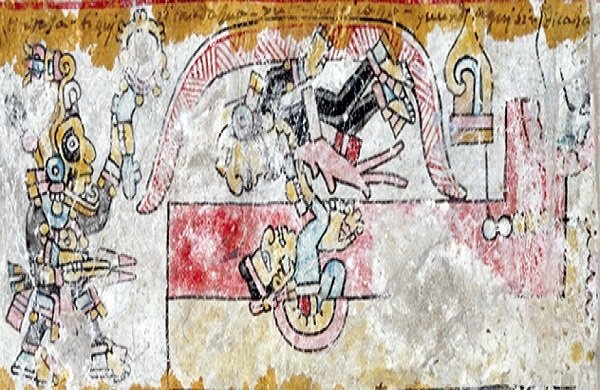
Scene of the death of 8 Jaguar Claw Deer in the Colombian codice. The image shows the separation of his spiritual body from his physical body at will, being able to do so thanks to his knowledge as Ya’a Yahui (Nahual).
The fall of Tula and Tlachihualtepetl/Cholula, at the hands of the Chichimecs
The death of the Mixtec Iya (King) 8 Jaguar Claw Deer, left an enormous power vacuum inside and outside the Mixtec. On the one hand, the Mixtec kingdoms became independent again, organized in confederations. On the other hand, in the absence of our hero, Tula and Cholula were finally successfully invaded by the Chichimecs from northern Mexican territory. A year after his death, in the year 1 Tecpatl, 1116 A.D., two important groups of Chichimecas arrived in the great city of Tula: The Tolteca-Chichimeca led by Tololohuitzil, Tezcahuitzil, Quetzaltehueyac and Icxicoatl, and the Nonoalca-Chichimeca led by Xelhuan, Huehuetzin, Cuauhtzin and Citlalmacuetzin. All of them requested asylum to Huemac, the ruler who ruled Tula after Quetzalcoatl. Huemac, chose the Nonoalca-Chichimeca as personal servants and guards of his palace, ordering them to find him a wife. The Nonoalca-Chichimeca accepted, taking the best woman they had among them. However Huemac despised her and the Nonoalca-Chichimeca. They became displeased with Huemac, and started an uprising. The Tolteca-Chichimeca, who were also servants of Huemac are summoned to defend the Tlahtoani, but they refuse to participate in a war they do not consider theirs, joining the Nonoalca-Chichimeca, defeating Huemac and sentencing him to death by arrowing.
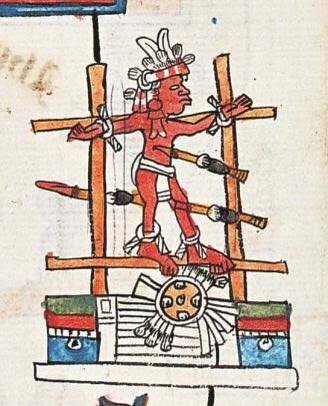
Death of Huemac, being executed by arrow. Illustrative image
To avoid problems, the Nonoalca-Chichimeca leave Tula, while the Tolteca-Chichimeca stay 15 more years. After some time, Couenan, a Tolteca-Chichimeca priest travels to Tlachihualtepetl (original name of Cholula) to do penance and ask for his people. In a vision, the god Quetzalcoatl tells him that he will deliver the city to them. After that, Couenan returns to Tula to deliver the message. Happy for the news, in the year 2 Tochtli, 1130 A.D., they decide to leave Tula, undertaking a migration in which they settle in different places; sometimes by peace, and others by force of arms. Finally, in the year 1 Tecpatl, 1168 AD. they finally arrived at Tlachihualtepetl, where they were dazzled by the undreamed wealth and strength of the Olmec Xicalancas (original owners and founders of the city) who treated the Tolteca-Chichimeca as servants, mocking them, and abusing them; throwing nixtamal water at them, scratching their legs with feathered canutes and straightening arrows and darts on their backs, according to the book “Historia Tolteca-Chichimeca”.
The Tolteca-Chichimeca cried out to the god Tezcatlipoca for help, who offers them a superb plan for revenge: The Tolteca-Chichimeca must go to the Tlahtoque (rulers) Xicalancas, saying that they want to ingratiate themselves with them, offering them in a ceremony a dance, they ask them for their macuahuitl (obsidian swords) and shields, but in order not to raise suspicion, they must ask for the old ones. The Olmec Xicalancas, full of arrogance and mowed down by their airs of superiority agree, without imagining what is about to happen: The Tolteca-Chichimeca overthrow them and conquer Tlachihualtepetl in the year 1168 A.D.
From then on, the city is known as Cholula, which means “The place of flight”, since the Olmeca Xicalanca had to flee to save their lives. The Toltec-Chichimeca took over the main area of the city, where the great pyramid was, and the Olmeca Xicalanca went to the southern part of the city.
For a time, they lived in harmony, until the year 6 House, 1173 A.D., when 7 villages in the area revolted with the Tolteca-Chichimeca, who sought to bring the Olmec Xicalancas back to power. The war went on for a year, weakening the resources and capabilities of the Tolteca-Chichimeca, who again appealed to the god Tezcatlipoca for help. Tezcatlipoca told them that they should return to their place of origin (Colhuacatepec or Chicomoztoc) to recruit more Chichimecs.
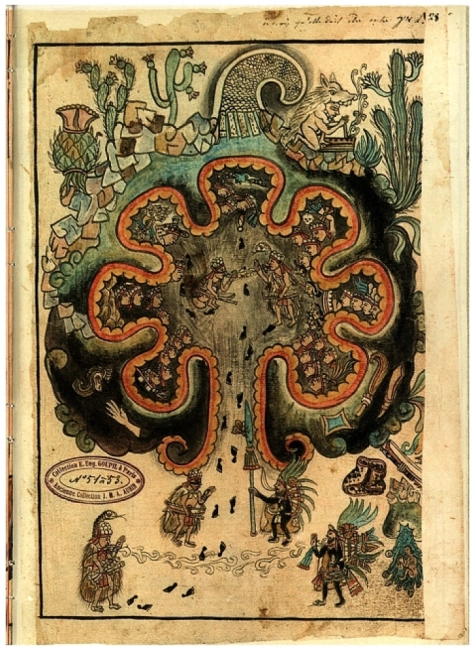
Chicomoztoc, image taken from the book/codice “Historia Tolteca-Chichimeca”.
According to the book “Historia Tolteca Chichimeca”, the towns settled in Chicomoztoc are: Cuautinchantlaca, Totomihuaque, Acolchichimeca, Tezauhteca, Zacateca, Texcaleca, and the Malpantlaca. However, it is important to mention that in the histories of other towns, they change the names of the towns that existed in this place, leaving open the possibility that other towns were found that the book “Historia Tolteca-Chichimeca” does not mention.
Icxicoatl and Quetzaltehueyac, tell the Chichimecas of Chicomoztoc that they have been sent by Tezcatlipoca to recruit them and offer them a better life. However, the Chichimeca are not interested in leaving, arguing that they have no need to fight with anyone, since they have more than enough resources and land. The Tolteca-Chichimeca tell them that if they help them they will achieve glory, and prosper much better than in Chicomoztoc, and they are finally convinced.
Icxicoatl, I take an ear of corn to husk. He then feeds the corn to Aquiyahuatl, Tzontecomatl, Teutlecozauhqui, Tecpanzin, Tzontecomatl and Moquihuix, the leaders of the Chichimeca, so that they could now speak Nahuatl, since the Tolteca-Chichimeca, having been in Tula for about 60 years, learned Nahuatl and forgot their native language. These Chichimeca leaders fasted for 4 days, drinking water and food brought to them by an eagle and a jaguar. They made self-sacrifice with maguey tips, and finally Icxicoatl and Quetzaltehueyac pierced their nasal ceptum, thus acquiring the rank of “Tecuhtli. After that, the Chichimecas made a symbolic ritual that consisted of arrowing nopaleras with red prickly pear cactus in order to spill its juice to the earth and thus feed the gods. After all these rituals, the Chichimec armies went out to help the Toltec-Chichimecs and put an end to the revolted peoples, finally defeating the Olmec Xicalanca and their allies in the year 1174, taking as pricioneros the defeated Tlahtoque (Kings): Cuauhtzitzitzimitl, Tlazohtli, Tzompantli and Yauhquicuiliuhqui, taking them to Cholula, and executing them by arrowing.
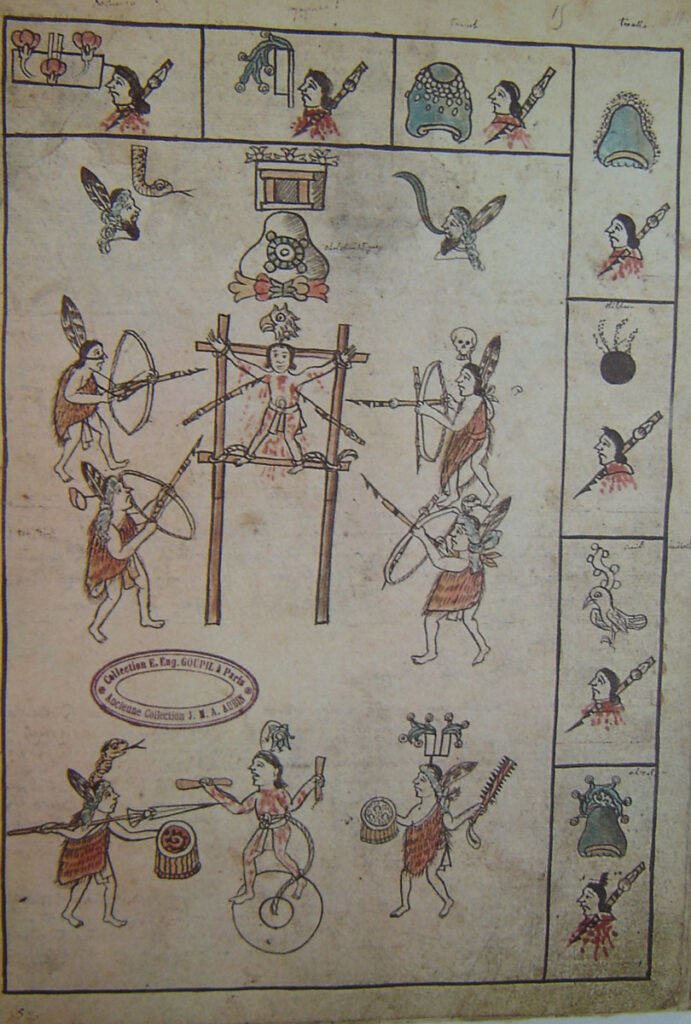
Death of the Olmec Xicalanca Tecuhtli (Kings) and their allies, executed by arrowing.
After the victory, the Toltec-Chichimeca, in gratitude, made the land available to their Chichimeca allies, so that they could look for the most convenient place for them to settle. In addition, they gave them some of their daughters to marry. Thus began a second pilgrimage of these peoples, founding new towns: The Texcaltecs founded Texcala, later known as Tlaxcala to the north, the Acolchichimecs founded Huexotzinco to the west, the Cuautinchantlaca founded Cuautinchan to the east, and the Totomihuaque founded Totomihuacan to the south, while the Tolteca-Chichimeca consolidated their power in Cholula, erecting a temple to Quetzalcoatl, the god who told the priest Couenan that he would give them this city. The Chichimec people who dispersed considered Cholula a sacred city, traveling there on important dates of their calendar to worship the god Quetzalcoatl.
From here, the book focuses on the history of Cuauhtlinchantlaca, as it was written there between 1540 and 1550, and was used to reclaim the lands they considered theirs at that time.
King Xolotl, and his capital Tenayuca
…To be continued…

